
More backlash against Let’s Go WA donors
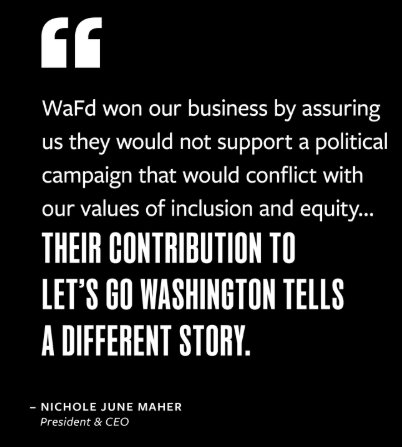
The $2 billion Inatai Foundation just announced they are ending their relationship with WaFd. “After reviewing Public Disclosure Commission filings, Inatai learned that our banking partner WaFd contributed $25,000 to the campaign backing initiatives that would make schools less safe for all Washington students—particularly queer, trans, and girl youth. …We believe our values should show up everywhere, not just in our grantmaking. They should guide who we contract with and who we do business with. And we will continue to use every tool available to us to help build a more just and equitable Washington.”
As we mentioned last week, multiple wholesale buyers announced a boycott of E9 beers after the owners of E9 brewery contributed to Let's Go Washington's 3 MAGA initiatives on the November ballot. Archie McPhee’s owner, Mark Pahlow issued an apology statement saying he had asked for a refund from Brian Heywood and Let’s Go Washington, and moved his donation of $10,000 to No Hate in WA State, the opposition coalition.
Trump helping to defeat I-645?
In a development that can’t possibly help I-645 sponsors attract support from Democrat voters, President Trump attacked Washington’s millionaires tax according to Fox 13. The fight was the subject of a feature in Sunday’s New York Times
….Progressives have described the repeal initiative as “a tax break for Brian Heywood and his friends.” They’ve also recruited their own pro-tax millionaires, including the travel writer and TV host Rick Steves, who lives in Edmonds, Wash., and the “Jeopardy!” host Ken Jennings, who commutes to California from Seattle to tape the quiz show. “I like the idea that we could bring back an America where it’s embarrassing for wealthy people to say, ‘Even though I could afford this, and it will improve public services in our state, I’d rather fight it,’” Mr. Jennings said.
School Board joins other municipalities in opposing Let’s Go WA ballot measures
Last week the Seattle School Board officially approved a resolution opposing all three ballot initiatives. Seattle School Board member Joe Mizrahi weighed in about why in an op-ed in The Urbanist “No matter what your political party affiliation is, most of us want our state to be a safe haven for people who value and respect each other, no matter where we are from, our race, religious beliefs, sexuality or gender identity. Voting no on these initiatives will powerfully refute the MAGA agenda’s attack on Washington’s way of life.”
The Seattle School Board joins the cities of Seattle, Tacoma, Mountlake Terrace, Shoreline, and the King County Council in opposing some or all of Let’s Go Washington’s initiatives.
Last week’s PDC ruling on a complaint regarding Let’s Go WA failure to disclose political spending leaves serious questions unanswered.
Let’s Go Washington invited influencer Brandi Kruse to speak at its February rally and advertised her appearance. PDC staff confirmed that she has charged Republican Party organizations for some speaking engagements. Her website also lists Brian Heywood’s Future 42 among its advertisers. PDC staff’s decision to stop investigating does not establish whether any payment connected to Future 42 supported her work on behalf of Let’s Go Washington’s initiatives.
Washingtonians For Ethical Government say that question merits further examination. Voters deserve a clear accounting when paid political work benefits a campaign. By her own admission in a series of tweets, Kruse is not a journalist. She calls herself a commentator. But she’s more than just a commentator. She’s an influencer and an unregistered commercial advertiser.
Influencers play a substantial role in shaping political debate. As a recent New York Times report on paid political creators illustrates, voters increasingly encounter political messages through voices they follow and trust. Washington’s Fair Campaign Practices Act must keep pace. California has already adopted disclosure requirements for paid influencer posts. Washington should strengthen its rules and laws so voters can keep following the money and track what influencers are active in state politics.
